- No categories



After the first session, mobile app usage goes way down, becoming almost non-existent by day 90.

Whether the phone is more secure than your cowhide wallet is not the point. Consumers are irrational folk and will adopt a technology on criteria that are not purely technological and not logical.

There I was, staring at my computer screen. Confused. Then it occurred to me, I was trying to find an iPad application – on my computer. My mobile life had collided with my computer life.

In many cases, marketers are still purchasing blind mobile buys and experiencing impressions discrepancies of up to 50 percent or more, making the need for verification necessary.

It has been surprising to see the snail’s pace at which the advertising industry has delivered innovation and new ideas for how to best reach the burgeoning mobile audience.

While there is room for new technology to transform how brands can reach consumers, competing markets and inherent weaknesses within each offering could hinder mainstream adoption.
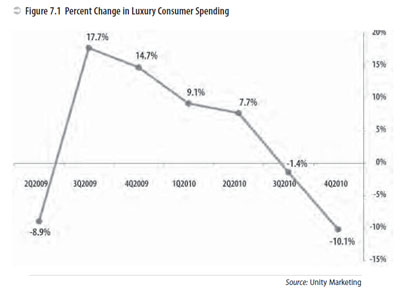
As Unity Marketing’s quarterly luxury tracking study has confirmed, American consumers are spending more on luxury goods and services in 2010 compared with 2009 and 2008—the depths of the recession.

Mobile search is surging, but the ability to get your product seen has never been more challenging.

Most organizations struggle with deciding which mobile channels to support. There are costs and trade-offs with each of the channels.

While mobile has been held as the promising new medium, it has really been applied somewhat as an adjunct to most brands’ main marketing programs.

Many retailers who consider themselves cross-channel are still struggling with a heavily siloed and disconnected environment.

With power shifting to the consumer, compressing margins and changing paradigms, retailers are employing a smarter commerce approach to buy, market, sell and service products.
While impeccable service, exclusive offers and personalized content are key elements for luxury brands, it is also important to recognize the customer’s on-the-go, connected lifestyle.

Much in the way that social media has engendered this shift for interpersonal and non-commercial experiences, proximity marketing represents an entirely new way to take in the commercial experience.

In addition to reaching settlements with Google and Twitter over their privacy practices, the Federal Trade Commission has stepped into another digital arena and filed its first lawsuit challenging a mobile marketing campaign.

In this rant, I am going to point out what many of you already know – that the iVerse is under attack. By whom, you ask? By a pairing of unlikely conspirators: Google and Amazon.

In the current Web-centric ecosystem for mobile advertising, carriers may not be a party to the transaction, but they may get blamed for privacy violations, scams or inappropriate or annoying ads.

While Web 2.0 delivered plenty of new tools and resources for creating and distributing content online, there was really only one new distribution channel – the browser. Not so now.

Few companies have taken the plunge to use Kinect as a marketing tool, but most have dragged their feet, preferring to let the technology mature rather than act as a guinea pig.
As the crises surrounding the recent earthquake, tsunami and nuclear disaster in Japan unfold, mobile giving has not been quite as prevalent as it was just a year ago for Haiti.

Hotel chains must leverage the growing consumption patterns of smartphone usage as an always-on device increasingly relied on by frequent travelers before, during and after their trips.